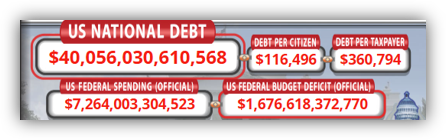
The US national debt, bond yields, and the bond market were hot topics for investors this week. First of all, the US national debt crossed the $40 trillion mark this week. It took 9 years to go from $10T to $20T of debt, 4.5 years to go from $20T to $30T, and another 4.5 years to go from $30T to $40T.
usdebtclock.org
Unfortunately, the US federal budget deficit number is underestimated above as the Treasury Department shows that the current fiscal year deficit is $1.8 trillion and will likely finish the year at $2.1 trillion. This is higher than forecasted due to lower tariff revenue and the refunding of previously collected tariffs that were struck down by the courts. The federal government must borrow more money to refund the $166 billion collected, but this is a windfall for companies receiving refunds, such as Walmart, who has stated they will use the billions they received to cut prices for consumers.
https://finance.yahoo.com/economy/policy/articles/walmart-used-3-billion-tariff-233922554.html
But now is not a good time to be borrowing more money. Bond yields have been rising since March on concerns the war in Iran will lead to higher inflation.
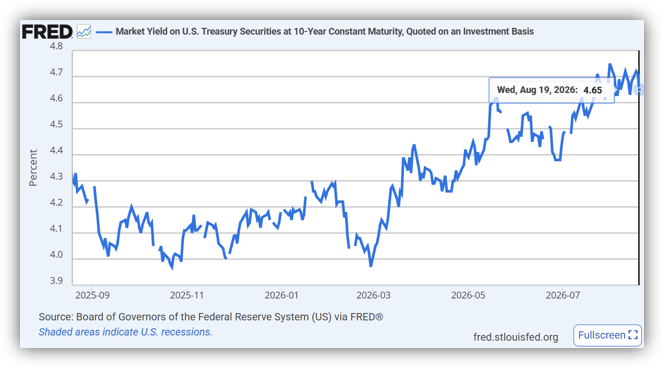
When inflation is higher, lenders typically demand a higher interest rate to account for the weaker currency they will receive when the loan comes due.
Additionally, the US government is finding itself competing with US companies when borrowing money as AI-related spending (and therefore, borrowing) is exploding higher.
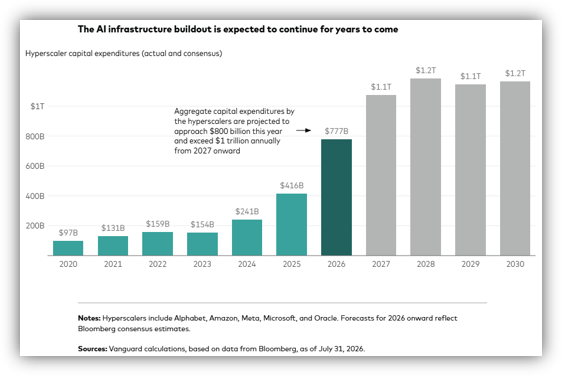
Estimates of total AI-related borrowing for full-year 2026—extending beyond the hyperscalers (Alphabet, Amazon, Microsoft, Meta, and Oracle) to the wider ecosystem of chipmakers, data-center developers, and utilities—range from roughly $300 billion to $570 billion. As spending is expected to increase dramatically in the years to come, bond issuance will as well.
With more options available to lenders in the investment-grade bond market going forward, the US government will likely pay higher interest rates than it otherwise would need to in order to attract buyers for its treasuries.
So rising bond yields (borrowing costs) caused the Treasury Department this week to interfere, I mean intervene, in the markets in an attempt to drive longer-term yields lower. These are the rates that most heavily impact mortgage rates, car loans, and other consumer lending rates.
Janet Yellen did something similar in 2023 when she was head of the Treasury Department, so while it can be a bit controversial, it’s not something new.
Meanwhile, stocks are marching higher as the borrowed money gets spent.
Have a great weekend.
Jack C. Harmon II, CFP®, CIMA
Principal, Harmon Financial Advisors
Registered Principal, Raymond James Financial Services
Harmon Financial Advisors, Inc. is an independent, fee-based financial planning firm and an independent Registered Investment Advisor. Investment advisory services offered through Raymond James Financial Services Advisors, Inc. and Harmon Financial Advisors, Inc. Securities offered through Raymond James Financial Services, Inc. Member FINRA/SIPC. Harmon Financial Advisors, Inc. is not a registered broker/dealer and is independent of Raymond James Financial Services, Inc.
The information contained in this report does not purport to be a complete description of the securities, markets, or developments referred to in this material. The information in this commercial email has been obtained from sources considered to be reliable, but we do not guarantee that the foregoing material is accurate or complete. Any information is not a complete summary or statement of all available data necessary for making an investment decision and does not constitute a recommendation. Any opinions are those of Harmon Financial Advisors, Inc. and not necessarily those of RJFS or Raymond James.
There is no guarantee that these statements, opinions, or forecasts provided herein will prove to be correct. Past performance may not be indicative of future results.
Investing involves risk and you may incur a profit or loss regardless of strategy selected. International investing involves special risks, including currency fluctuations, differing financial accounting standards, and possible political and economic volatility.
Keep in mind that individuals cannot invest directly in any index, and index performance does not include transaction costs or other fees, which will affect actual investment performance. Individual investors’ results will vary.
Certified Financial Planner Board of Standards Inc. owns the certification marks CFP®, CERTIFIED FINANCIAL PLANNER®, and CFP® in the U.S., which it awards to individuals who successfully complete CFP Board’s initial and ongoing certification requirements.
Investments & Wealth Institute™ (The Institute) is the owner of the certification marks “CIMA” and “Certified Investment Management Analyst.” Use of CIMA and/or Certified Investment Management Analyst signifies that the user has successfully completed The Institute’s initial and ongoing credentialing requirements for investment management professionals.