Stocks continued their climb higher in August after a summer pause in June and July.
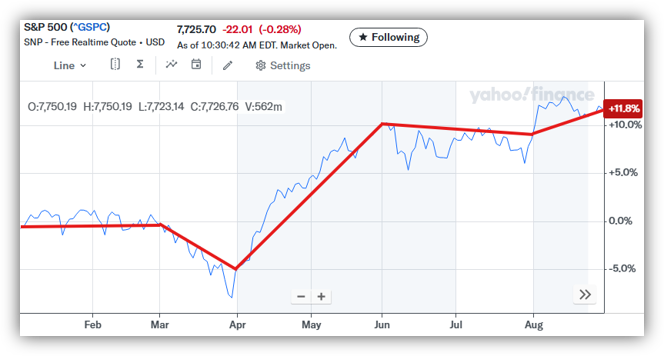
Source: Yahoo Finance
This morning we received the August jobs report showing that 162,000 jobs were created last month, many more than expected (forecast was for 53,000 jobs). Bars and restaurants led in job creation, while information-related sectors saw a loss, possibly owing to AI investment. The unemployment rate remained at 4.1%, in line with what Federal Reserve officials have called a stable labor market.
But the real story this week has been in the bond market as yields have continued to rise around the world.
Japan’s 10-year bond yield hit 3% this week for the first time since 1996.
Britain’s 30-year bond yield hit a 30-year high.
German yields hit a 15-year high this week.
French yields are the highest since 2008.
US yields are flirting with levels last seen prior to the Financial Crisis of 2008.
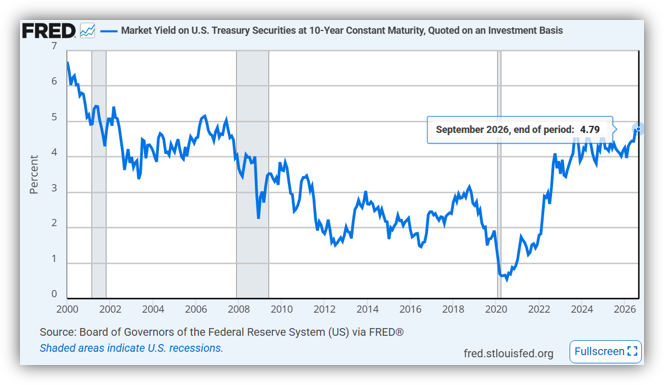
Source: fred.stlouisfed.org
So, what’s going on here? We wrote about one relatively new factor affecting the bond market a couple of weeks ago – the massive influx of investment-grade bonds from US tech companies borrowing money to fund the AI build-out. As governments and corporations must compete for a limited number of lenders (bond buyers), yields typically rise to entice buyers. This week, at least three more factors have been added to the discussion.
- The bond market is adapting to higher inflation expectations related to the war in the Middle East. The price of oil has risen from $57 per barrel at the beginning of the year to over $90 per barrel today. As the situation moves from an affair expected to last a couple of months to an open-ended engagement, bond buyers are demanding higher yields to keep up with higher expected inflation driven by higher global energy prices.
- The total national debt is now over $40 trillion and $9 trillion of it becomes due this year. The US government has been flooding the market with newly issued treasuries to refinance it. When a US treasury bond, note, or bill matures, the US government does not have the money to repay the bondholder, so it must sell a new bond to pay off the old one. The older bonds had lower interest rates, so when the government sells a new bond at today’s interest rates, US debt financing costs go up. Of our approximate $7 trillion annual federal budget, over $1 trillion is already going to interest payments on existing treasuries.
- Finally, bond buyers don’t see any reason to believe that borrowing countries will get their financial house in order anytime soon. As such, they will demand higher yields to compensate for the higher perceived risk.
What is happening in the bond market is normal and certainly no reason to panic. Rising yields are not creating a crisis. Ultimately, the bond market is sending a message to borrowers that there are consequences for irresponsible policy decisions and it’s not too late to change course.
Have a great weekend.
Jack C. Harmon II, CFP®, CIMA
Principal, Harmon Financial Advisors
Registered Principal, Raymond James Financial Services
Harmon Financial Advisors, Inc. is an independent, fee-based financial planning firm and an independent Registered Investment Advisor. Investment advisory services offered through Raymond James Financial Services Advisors, Inc. and Harmon Financial Advisors, Inc. Securities offered through Raymond James Financial Services, Inc. Member FINRA/SIPC. Harmon Financial Advisors, Inc. is not a registered broker/dealer and is independent of Raymond James Financial Services, Inc.
The information contained in this report does not purport to be a complete description of the securities, markets, or developments referred to in this material. The information in this commercial email has been obtained from sources considered to be reliable, but we do not guarantee that the foregoing material is accurate or complete. Any information is not a complete summary or statement of all available data necessary for making an investment decision and does not constitute a recommendation. Any opinions are those of Harmon Financial Advisors, Inc. and not necessarily those of RJFS or Raymond James.
There is no guarantee that these statements, opinions, or forecasts provided herein will prove to be correct. Past performance may not be indicative of future results.
Investing involves risk and you may incur a profit or loss regardless of strategy selected. International investing involves special risks, including currency fluctuations, differing financial accounting standards, and possible political and economic volatility.
The S&P 500 is an unmanaged index of 500 widely held stocks that is generally considered representative of the U.S. stock market.
Keep in mind that individuals cannot invest directly in any index, and index performance does not include transaction costs or other fees, which will affect actual investment performance. Individual investors’ results will vary.
Certified Financial Planner Board of Standards Inc. owns the certification marks CFP®, CERTIFIED FINANCIAL PLANNER®, and CFP® in the U.S., which it awards to individuals who successfully complete CFP Board’s initial and ongoing certification requirements.
Investments & Wealth Institute™ (The Institute) is the owner of the certification marks “CIMA” and “Certified Investment Management Analyst.” Use of CIMA and/or Certified Investment Management Analyst signifies that the user has successfully completed The Institute’s initial and ongoing credentialing requirements for investment management professionals.