Unfolding events in the Middle East continue to be the primary driver behind market movements due to their impact on global energy supply. While a cease fire is better than no cease fire, the US and Iran are still very far apart when it comes to negotiating a permanent end to the hostilities. The markets are sensitive to every sign of hope, but there remains good reason to be skeptical the two sides can come together in the next week or two.
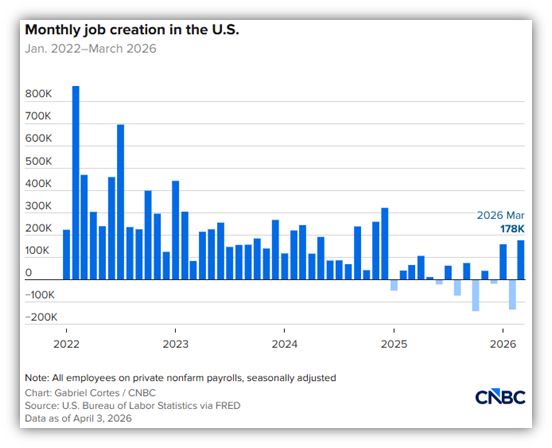
Meanwhile, on the home front, economic data continues to show a very resilient US economy. The March jobs report showed that 178,000 jobs were created last month vs. a forecasted gain of just 59,000 jobs AND the unemployment rate fell to 4.3%. This was welcome news after February’s loss of 133,000 jobs.
Additionally, estimates for 1st quarter US economic growth (GDP) are somewhere between 1.3% (Atlanta Fed) and 2.4% (New York Fed). Economic growth for the remainder of the year is expected to get a boost from tax refunds. According to the Tax Foundation, recent data shows average refunds are up approximately 11% over last year.
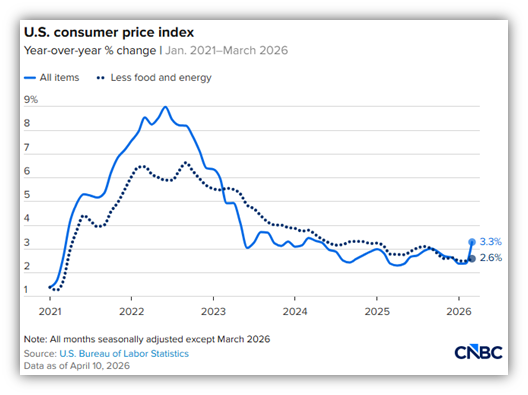
However, the stimulative effect of larger refunds will be blunted to some degree by higher energy costs now, and possibly higher overall prices later in the year. The annual inflation rate rose to 3.3% in March, pushed by a 10.9% surge in energy costs. When we strip out food and energy (called Core CPI), the inflation rate remained a relatively tame 2.6%.
If energy prices remain elevated, or move even higher from here, those costs will ripple through the system and drag the prices of many other goods and services higher. While larger tax refunds can help consumers deal with higher prices, the refunds wouldn’t give the economy the boost currently expected and already priced into the markets.
Have a great weekend.
Jack C. Harmon II, CFP®, CIMA
Principal, Harmon Financial Advisors
Registered Principal, Raymond James Financial Services
Harmon Financial Advisors, Inc. is an independent, fee-based financial planning firm and an independent Registered Investment Advisor. Investment advisory services offered through Raymond James Financial Services Advisors, Inc. and Harmon Financial Advisors, Inc. Securities offered through Raymond James Financial Services, Inc. Member FINRA/SIPC. Harmon Financial Advisors, Inc. is not a registered broker/dealer and is independent of Raymond James Financial Services, Inc.
The information contained in this report does not purport to be a complete description of the securities, markets, or developments referred to in this material. The information in this commercial email has been obtained from sources considered to be reliable, but we do not guarantee that the foregoing material is accurate or complete. Any information is not a complete summary or statement of all available data necessary for making an investment decision and does not constitute a recommendation. Any opinions are those of Harmon Financial Advisors, Inc. and not necessarily those of RJFS or Raymond James.
There is no guarantee that these statements, opinions, or forecasts provided herein will prove to be correct. Past performance may not be indicative of future results.
Investing involves risk and you may incur a profit or loss regardless of strategy selected. International investing involves special risks, including currency fluctuations, differing financial accounting standards, and possible political and economic volatility
Keep in mind that individuals cannot invest directly in any index, and index performance does not include transaction costs or other fees, which will affect actual investment performance. Individual investor’s results will vary.
Bond prices and yields are subject to change based upon market conditions and availability. If bonds are sold prior to maturity, you may receive more or less than your initial investment. There is an inverse relationship between interest rate movements and fixed income prices. Generally, when interest rates rise, fixed income prices fall and when interest rates fall, fixed income prices rise.
Certified Financial Planner Board of Standards Inc. owns the certification marks CFP®, CERTIFIED FINANCIAL PLANNER®, and CFP® in the U.S., which it awards to individuals who successfully complete CFP Board’s initial and ongoing certification requirements.
Investments & Wealth Institute™ (The Institute) is the owner of the certification marks “CIMA” and “Certified Investment Management Analyst.” Use of CIMA and/or Certified Investment Management Analyst signifies that the user has successfully completed The Institute’s initial and ongoing credentialing requirements for investment management professionals.