There are a couple of publications that come out every year that we look forward to reading. The first is a survey of market forecasts from major investment firms. We know these forecasts, known as capital market assumptions (CMAs), are the foundation upon which institutional portfolios (pension funds, college endowments, foundations) are designed and managed. The fundamental difference between how institutional portfolios and individual portfolios are managed is that institutional portfolios are anchored in these forward-looking return assumptions while most individuals’ portfolios are notoriously influenced by what has performed well recently. This is known as recency bias, and it keeps most individual investors chasing after yesterday’s returns.
This survey of forecasts is compiled and published every August and is now available. Here is a list of this year’s 43 participants.
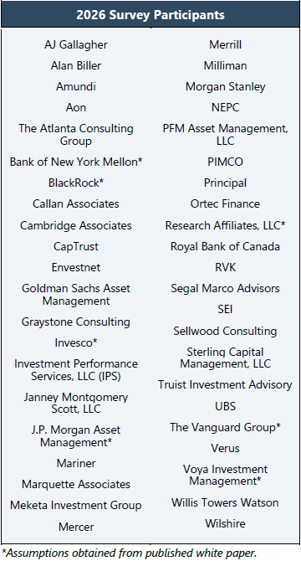
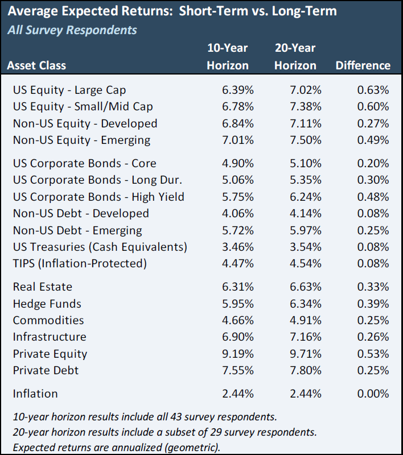
Given the large number of firms, and with such big names as BlackRock, Goldman Sachs, JP Morgan, and Vanguard, we see this survey as a sort of “industry consensus” for market expectations. Submissions from all participants are compiled into an average set of forecasts and published as follows.
We’re thankful to Horizon Actuarial Services for publishing this annual report and you can find it on their website.
https://www.horizonactuarial.com/survey-of-capital-market-assumptions
Most of these forecasts are a little lower than last year, but they still have the same problem for investors. The spread between forecasted stock and bond returns is small. For example, various combinations of US large cap stocks and core bonds are expected to yield only mildly different returns.
100% stocks = 6.39%
60% stocks, 40% bonds = 5.79%
30% stocks, 70% bonds = 5.35%
Now we admit that no one has a crystal ball, and no one knows what future returns will be. While institutional investors take these numbers seriously and invest trillions of dollars accordingly, many individual investors look at these numbers and dismiss them as ridiculously low. However, expecting higher market returns because we’ve recently experienced higher market returns is the very definition of recency bias.
So, what are institutional investors doing in this environment? That’s where our second annually anticipated publication comes in. Each year the National Association of College and University Business Officers (NACUBO) publishes a survey of college endowments. Looking across the nearly $1 trillion invested in 657 participating endowment portfolios, we see the following investment allocation this year.
31% publicly traded stocks
11% fixed income (bonds)
45% alternative investment strategies
10% real assets
3% other
The latest report can be found here – https://www.nacubo.org/Research/2026/NACUBO-Commonfund-Study-of-Endowments
More than half of the money invested in college endowment portfolios today is invested in something other than stocks and bonds. The current outlook for traditional investments makes alternatives, which may provide returns as good or better than equities while potentially lowering portfolio risk through broader diversification, very attractive. And fortunately, individual investors are gaining access to more alternative strategies every month.
I spoke with an investment advisor this week who was beginning to use alternative investments in his clients’ portfolios, but it became quickly apparent that he wasn’t doing anything more than picking a few of the recently best performing strategies. While many things may change, there will always be new ways to make the same old mistakes.
Have a great weekend.
Jack C. Harmon II, CFP®, CIMA
Principal, Harmon Financial Advisors
Registered Principal, Raymond James Financial Services
Harmon Financial Advisors, Inc. is an independent, fee-based financial planning firm and an independent Registered Investment Advisor. Investment advisory services offered through Raymond James Financial Services Advisors, Inc. and Harmon Financial Advisors, Inc. Securities offered through Raymond James Financial Services, Inc. Member FINRA/SIPC. Harmon Financial Advisors, Inc. is not a registered broker/dealer and is independent of Raymond James Financial Services, Inc.
The information contained in this report does not purport to be a complete description of the securities, markets, or developments referred to in this material. The information in this commercial email has been obtained from sources considered to be reliable, but we do not guarantee that the foregoing material is accurate or complete. Any information is not a complete summary or statement of all available data necessary for making an investment decision and does not constitute a recommendation. Any opinions are those of Harmon Financial Advisors, Inc. and not necessarily those of RJFS or Raymond James.
There is no guarantee that these statements, opinions, or forecasts provided herein will prove to be correct. Past performance may not be indicative of future results.
Investing involves risk and you may incur a profit or loss regardless of strategy selected. International investing involves special risks, including currency fluctuations, differing financial accounting standards, and possible political and economic volatility.
Keep in mind that individuals cannot invest directly in any index, and index performance does not include transaction costs or other fees, which will affect actual investment performance. Individual investors’ results will vary.
Certified Financial Planner Board of Standards Inc. owns the certification marks CFP®, CERTIFIED FINANCIAL PLANNER®, and CFP® in the U.S., which it awards to individuals who successfully complete CFP Board’s initial and ongoing certification requirements.
Investments & Wealth Institute™ (The Institute) is the owner of the certification marks “CIMA” and “Certified Investment Management Analyst.” Use of CIMA and/or Certified Investment Management Analyst signifies that the user has successfully completed The Institute’s initial and ongoing credentialing requirements for investment management professionals.