


Nervous tech investors rocked the markets this week as the tech-heavy Nasdaq index lost more than $1.5 trillion in market value according to CNN and FactSet data. It was the worst 3 days for the index since the major tariff announcements last April.
The primary trigger behind this week’s market selloff was the announcement from AI company Anthropic that its AI tools were being deployed in legal and accounting applications.
This quickly raised fears that AI could soon replace many software tools and services, sending software stocks sharply lower and shedding $830 billion in market valuation in six trading days.
https://abcnews.go.com/Business/new-ai-tool-hammered-software-stocks-week/story?id=129845251
https://www.cnn.com/2026/02/04/investing/us-stocks-anthropic-software
This is a great example of the uncertainty new technology, in this case AI, brings to the markets. Disruptive innovation always creates winners and losers, and the stakes are high to be on the right side of the future. Fear that software companies could soon be net losers triggered a shoot first and ask questions later response by investors this week.
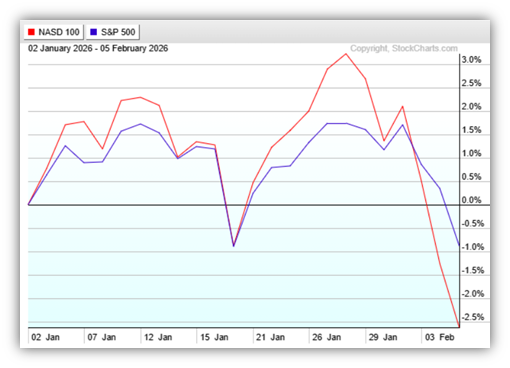
The Nasdaq index is in red, and the broader S&P 500 index is in blue.
Adding to investor concerns was the announcement this week that job openings were down and layoffs were up for January. Additionally, the collapse in the price of Bitcoin, down by over 25% in the past 30 days, could be causing some spillover effect into the equity markets as well.
As of Friday morning, markets were rebounding. All in all, we see this as normal market volatility as the primary tailwinds supporting the economy this year remain intact.
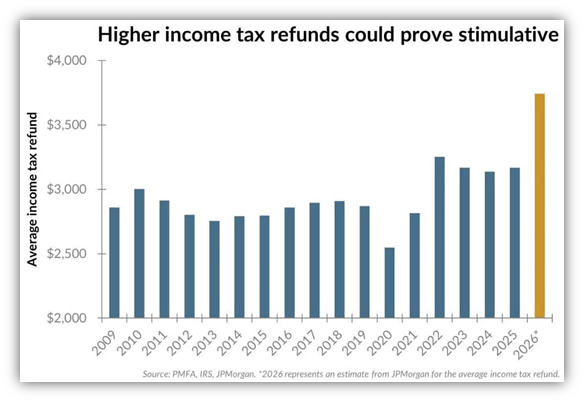
- Tax cuts will result in rising tax refunds early this year, stimulating consumer spending. JP Morgan estimates consumers will receive an extra $50 billion – $100 billion because of the tax cuts.
- Corporate spending (capital expenditures, or Capex) on both AI and non-AI related items is likely to increase due to lower interest rates and accelerated depreciation of equipment from the tax cut act.
- It’s an election year. The party in power typically supports stimulative economic policies in election years to juice the economy (and hopefully markets) leading up to November.
Have a great weekend.
Jack C. Harmon II, CFP®, CIMA
Principal, Harmon Financial Advisors
Registered Principal, Raymond James Financial Services
Harmon Financial Advisors, Inc. is an independent, fee-based financial planning firm and an independent Registered Investment Advisor. Investment advisory services offered through Raymond James Financial Services Advisors, Inc. and Harmon Financial Advisors, Inc. Securities offered through Raymond James Financial Services, Inc. Member FINRA/SIPC. Harmon Financial Advisors, Inc. is not a registered broker/dealer and is independent of Raymond James Financial Services, Inc.
The information contained in this report does not purport to be a complete description of the securities, markets, or developments referred to in this material. The information in this commercial email has been obtained from sources considered to be reliable, but we do not guarantee that the foregoing material is accurate or complete. Any information is not a complete summary or statement of all available data necessary for making an investment decision and does not constitute a recommendation. Any opinions are those of Harmon Financial Advisors, Inc. and not necessarily those of RJFS or Raymond James.
There is no guarantee that these statements, opinions, or forecasts provided herein will prove to be correct. Past performance may not be indicative of future results.
Investing involves risk and you may incur a profit or loss regardless of strategy selected. International investing involves special risks, including currency fluctuations, differing financial accounting standards, and possible political and economic volatility
Keep in mind that individuals cannot invest directly in any index, and index performance does not include transaction costs or other fees, which will affect actual investment performance. Individual investor’s results will vary.
The S&P 500 is an unmanaged index of 500 widely held stocks that is generally considered representative of the U.S. stock market.
The Nasdaq Composite Index is a market capitalization-weighted index of more than 2,500 stocks listed on the Nasdaq stock exchange. It is a broad index that is heavily weighted toward the important technology sector.
Bond prices and yields are subject to change based upon market conditions and availability. If bonds are sold prior to maturity, you may receive more or less than your initial investment. There is an inverse relationship between interest rate movements and fixed income prices. Generally, when interest rates rise, fixed income prices fall and when interest rates fall, fixed income prices rise.
Certified Financial Planner Board of Standards Inc. owns the certification marks CFP®, CERTIFIED FINANCIAL PLANNER®, and CFP® in the U.S., which it awards to individuals who successfully complete CFP Board’s initial and ongoing certification requirements.
Investments & Wealth Institute™ (The Institute) is the owner of the certification marks “CIMA” and “Certified Investment Management Analyst.” Use of CIMA and/or Certified Investment Management Analyst signifies that the user has successfully completed The Institute’s initial and ongoing credentialing requirements for investment management professionals.

