It was a tough week for stocks as markets woke up Monday morning to the news that the US and Israel had begun military strikes against Iran, shifting investors primary focus away from AI and the economy, but now to war. While the markets have recently become quite resilient when faced with news of military action somewhere in the world, this is different because of its potential impact on global energy markets.
30% of all oil shipping and 20% of all liquified natural gas (LNG) passes through a 24-mile-wide passage called the Strait of Hormuz. Iran announced this week that the strait was closed, using it as a weapon of mass economic destruction, to put global pressure on the US and Israel to end the attacks.
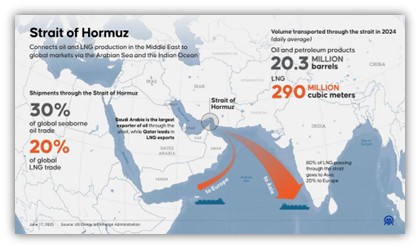
Over 60% of the oil passing through the strait comes from Saudi Arabia and Iraq, with just 10% originating from Iran. Over 50% of the oil is destined for China and India. This has sent buyers scrambling for other sources and pushing up oil prices all over the world. It appears that Russia may be the big winner for now, benefitting from higher demand and higher prices, at least as long as shipping through the strait is impacted.
https://www.cnbc.com/2026/03/06/us-india-waiver-russian-oil-iran-war-energy-supply-worries-.html
The sudden reduction of oil supply has driven the price of oil from roughly $67 per barrel a week ago, to almost $90 per barrel today. So, while oil was up this week, stocks were down, bonds were disappointingly down, the US dollar strengthened, gold was down, and commodities were up.
While markets expect this spike in oil prices to be temporary, the impact on global economies could be significant if energy prices remain elevated for too long.
We expect to see larger than average moves in the markets, both higher and lower, over the coming weeks as speculative investors over-react to developing news out of the Middle East.
On Friday we received the February labor report, showing that the US economy lost 92,000 jobs last month and the unemployment rate ticked up to 4.4%. Key factors were severe winter weather, a strike at Kaiser Permanente that sidelined 30,000 workers, and continued losses in information services jobs due to AI-related cuts. Even taking these impacts into account, it was still a weak jobs number.
While the jobs picture was weak, wages rose more than expected. Average hourly earnings increased 0.4% for the month and 3.8% from a year ago, both 0.1 percentage point above forecast.
https://www.cnbc.com/2026/03/06/february-2026-jobs-report.html
Our proprietary tactical model is weathering the current market volatility by recommending a very broad mix of assets. As of Thursday,
18% US stocks
22% Non-US stocks
10% Utility stocks
20% Gold
15% Commodities
10% Bonds
5% Cash
Have a great weekend.
Jack C. Harmon II, CFP®, CIMA
Principal, Harmon Financial Advisors
Registered Principal, Raymond James Financial Services
Harmon Financial Advisors, Inc. is an independent, fee-based financial planning firm and an independent Registered Investment Advisor. Investment advisory services offered through Raymond James Financial Services Advisors, Inc. and Harmon Financial Advisors, Inc. Securities offered through Raymond James Financial Services, Inc. Member FINRA/SIPC. Harmon Financial Advisors, Inc. is not a registered broker/dealer and is independent of Raymond James Financial Services, Inc.
The information contained in this report does not purport to be a complete description of the securities, markets, or developments referred to in this material. The information in this commercial email has been obtained from sources considered to be reliable, but we do not guarantee that the foregoing material is accurate or complete. Any information is not a complete summary or statement of all available data necessary for making an investment decision and does not constitute a recommendation. Any opinions are those of Harmon Financial Advisors, Inc. and not necessarily those of RJFS or Raymond James.
There is no guarantee that these statements, opinions, or forecasts provided herein will prove to be correct. Past performance may not be indicative of future results.
Investing involves risk and you may incur a profit or loss regardless of strategy selected. International investing involves special risks, including currency fluctuations, differing financial accounting standards, and possible political and economic volatility
Keep in mind that individuals cannot invest directly in any index, and index performance does not include transaction costs or other fees, which will affect actual investment performance. Individual investor’s results will vary.
Bond prices and yields are subject to change based upon market conditions and availability. If bonds are sold prior to maturity, you may receive more or less than your initial investment. There is an inverse relationship between interest rate movements and fixed income prices. Generally, when interest rates rise, fixed income prices fall and when interest rates fall, fixed income prices rise.
Certified Financial Planner Board of Standards Inc. owns the certification marks CFP®, CERTIFIED FINANCIAL PLANNER®, and CFP® in the U.S., which it awards to individuals who successfully complete CFP Board’s initial and ongoing certification requirements.
Investments & Wealth Institute™ (The Institute) is the owner of the certification marks “CIMA” and “Certified Investment Management Analyst.” Use of CIMA and/or Certified Investment Management Analyst signifies that the user has successfully completed The Institute’s initial and ongoing credentialing requirements for investment management professionals.