Oil and interest rates were the primary factors moving markets this week. Oil remains above $100 per barrel this morning and has risen almost 20% in the past month.
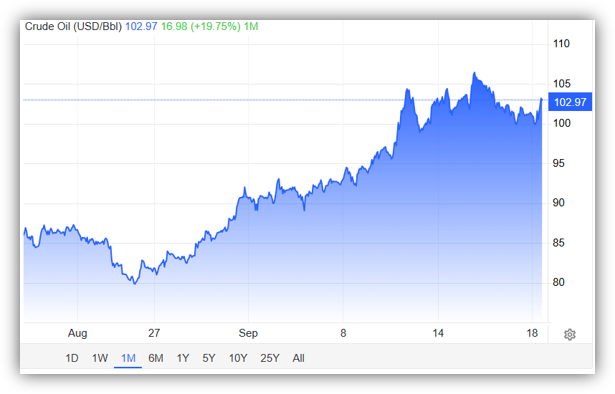
https://tradingeconomics.com/commodity/crude-oil
Adding to the impacts of higher current oil prices is the uncertainty going forward. Many analysts, such as those at JP Morgan, are giving up on predicting possible outcomes for the Iran conflict.
“For the first time since the start of the Iran conflict, we don’t have a baseline view,” said Natasha Kaneva, head of global commodities strategy at JPMorgan, in a note published Thursday. “We simply don’t know how to model the endgame.”
https://finance.yahoo.com/energy/articles/jpmorgan-drops-iran-war-oil-115416515.html
However, higher oil prices don’t affect Americans at the gas pump in the same way they once did. The cost of gasoline as a percentage of disposable income is near historic lows as Americans spend an average of 2.5% of their income at the pump, down from over 6% in the 1970s and 1980s. The real concern is what higher gas prices do to the cost of everything else.
As higher energy prices ripple through the economy, transportation costs are likely to push inflation higher. This caused the Fed to raise interest rates this week for the first time since 2023, with another rate hike expected before yearend. As I mentioned last week, the Fed believes the US economy is strong enough to withstand higher interest rates to fight inflation and Fed Chair Kevin Warsh said exactly that this week:
“We now have data broadly defined that says the economy has indeed strengthened,” Fed Chairman Kevin Warsh said in a press conference following the meeting. “Underlying growth is higher. Inflation is the problem. Stable prices have been the problem for, now, more than five and a half years.
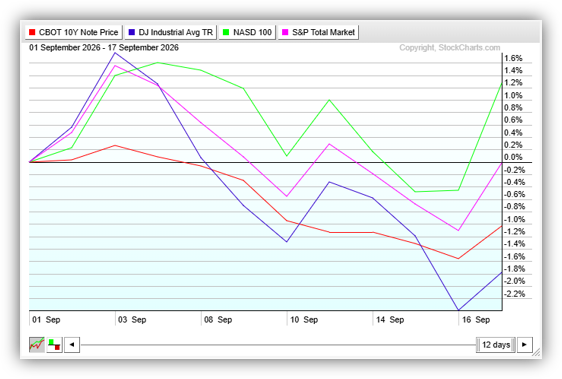
So far for September, the US total stock market index is flat (pink), but the tech-heavy Nasdaq (green) is up over 1% while the Dow Jones Industrial Average (blue) is down nearly 2%. Bonds (red) are down about 1%.
Have a great weekend.
Jack C. Harmon II, CFP®, CIMA
Principal, Harmon Financial Advisors
Registered Principal, Raymond James Financial Services
Harmon Financial Advisors, Inc. is an independent, fee-based financial planning firm and an independent Registered Investment Advisor. Investment advisory services offered through Raymond James Financial Services Advisors, Inc. and Harmon Financial Advisors, Inc. Securities offered through Raymond James Financial Services, Inc. Member FINRA/SIPC. Harmon Financial Advisors, Inc. is not a registered broker/dealer and is independent of Raymond James Financial Services, Inc.
The information contained in this report does not purport to be a complete description of the securities, markets, or developments referred to in this material. The information in this commercial email has been obtained from sources considered to be reliable, but we do not guarantee that the foregoing material is accurate or complete. Any information is not a complete summary or statement of all available data necessary for making an investment decision and does not constitute a recommendation. Any opinions are those of Harmon Financial Advisors, Inc. and not necessarily those of RJFS or Raymond James.
There is no guarantee that these statements, opinions, or forecasts provided herein will prove to be correct. Past performance may not be indicative of future results.
Investing involves risk and you may incur a profit or loss regardless of strategy selected. International investing involves special risks, including currency fluctuations, differing financial accounting standards, and possible political and economic volatility.
The S&P Total Market Index (TMI) is designed to track the broad equity market, including large-, mid-, small-, and micro-cap stocks.
The Nasdaq Composite Index is a market capitalization-weighted index of more than 2,500 stocks listed on the Nasdaq stock exchange. It is a broad index that is heavily weighted toward the important technology sector.
The Dow Jones Industrial Average (DJIA), commonly known as “The Dow” is an index representing 30 stocks of companies maintained and reviewed by the editors of the Wall Street Journal.
Keep in mind that individuals cannot invest directly in any index, and index performance does not include transaction costs or other fees, which will affect actual investment performance. Individual investors’ results will vary.
Certified Financial Planner Board of Standards Inc. owns the certification marks CFP®, CERTIFIED FINANCIAL PLANNER®, and CFP® in the U.S., which it awards to individuals who successfully complete CFP Board’s initial and ongoing certification requirements.
Investments & Wealth Institute™ (The Institute) is the owner of the certification marks “CIMA” and “Certified Investment Management Analyst.” Use of CIMA and/or Certified Investment Management Analyst signifies that the user has successfully completed The Institute’s initial and ongoing credentialing requirements for investment management professionals.
Investing in oil involves special risks, including the potential adverse effects of state and federal regulation and may not be suitable for all investors.
U.S. government bonds and Treasury notes are guaranteed by the U.S. government and, if held to maturity, offer a fixed rate of return and guaranteed principal value. U.S. government bonds are issued and guaranteed as to the timely payment of principal and interest by the federal government. Treasury notes are certificates reflecting intermediate-term (2 – 10 years) obligations of the U.S. government.